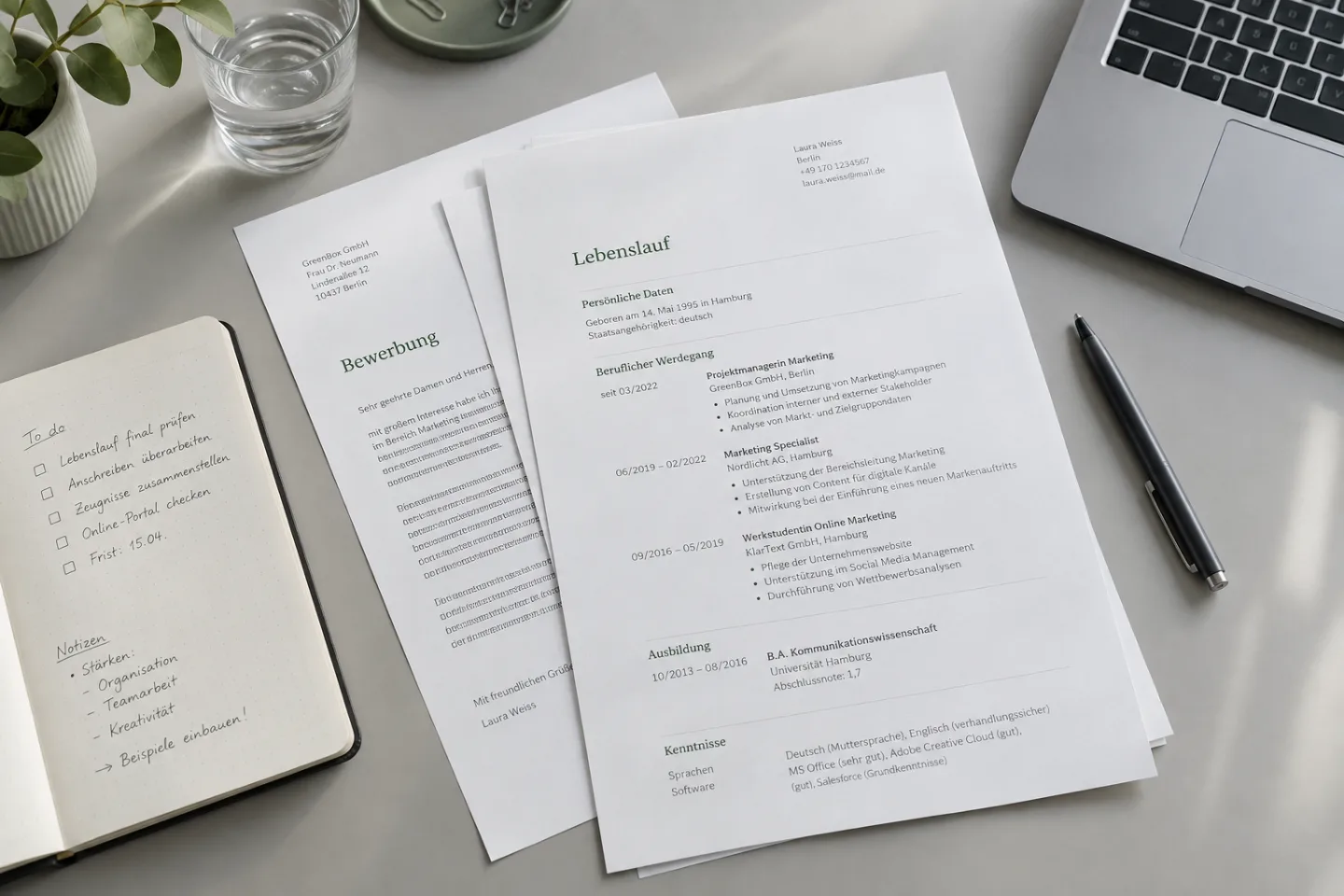
A strong resume makes your current role, relevant experience and concrete contributions clear at a glance. Start with the most recent role, cut what does not matter and check the finished export as a PDF instead of only the view in the editor.
Clarify the content first. Then choose the layout.
Which three tasks from the posting matter most?
Note matching projects, contributions and results from your roles.
Give the strongest evidence the most space – not the oldest role.
How is a resume structured?
A resume should answer a simple question: Which of your past experiences shows that you can handle the tasks of the new role? That is why the order is not an end in itself. It helps readers grasp your current situation, your career path and your most important skills quickly.
For many people already working, a reverse chronological structure works best: the current or most recent role comes first, then you move back step by step. The Federal Employment Agency recommends a chronological resume in table form with the most recent experience first and names one to two pages in A4 format as a guide.
You do not have to use every section. A short profile can help when you are changing fields, but it can also waste space on a straight career path. Projects often matter more for people starting out or for technical and creative roles than they do for other applications. The choice should follow your actual profile and the job.
Which personal details belong on the page?
Your full name and contact routes that actually reach you are essential. Use a professional email address and check the phone number and spelling with extra care. An address can make sense depending on how you apply and on company practice; international or fully digital applications treat it in different ways.
Photo and optional details
An application photo is not required in Germany. Details such as marital status or nationality are also not needed as a rule. Decide with intent whether an optional piece of information really helps your application. If you use a photo, it should be current and professional – a selfie or a vacation picture tends to pull attention away from the content.
Avoid data that does not usefully inform the hiring decision. A resume is not a complete personal file. It is a professional summary for a specific selection decision.
Describe work experience so it is easy to understand
Job titles and employers show where you worked. They still do not explain what you contributed. Strong bullet points therefore connect three layers: the context, your concrete contribution and a visible change. Not every line needs a metric. Every important line should still be specific enough that you can explain it in a conversation.
“Responsible for looking after important clients.”
“Supported twelve business clients, coordinated internal questions and introduced a fixed monthly review for open decisions.”
The second version does not claim an invented success. It simply makes scope, collaboration and working style visible. If there was a result you can prove, you can add it: shorter handling times, fewer follow up questions, more stable processes or a finished project. Use only numbers you can truly explain.
A practical sentence formula
Active verb + concrete task + relevant context + a result you can verify. For example: “Analyzed recurring support requests, grouped the most common causes and wrote five new help articles for the service team.” The formula is a tool, not a rule you must follow. Short role descriptions, the scope of your responsibility and individual results may take turns.
Verbs that make responsibility visible
Choose verbs that match your actual role: developed, coordinated, analyzed, introduced, reviewed, supported, negotiated, prioritized or documented. “Collaborated” can be honest, but on its own it says little. Add which part you took on. Use “led” only when you truly held responsibility for people, decisions or a body of work.
Everyday notes become usable bullet points
Fictional rough note: “Sold in the store, trained new colleagues, handled complaints. Spoke with store management on difficult cases.”
For an application in customer service, that could become two bullet points:
- Advised customers on products, handled complaints and aligned special cases with store management.
- Trained new team members in advising, the checkout system and return processes.
The experience stays the same. What becomes visible is advising, solving problems and passing on knowledge. Training someone is not people management; aligning with others is not a solo decision. Keep that same boundary in your own wording.
What a complete role can look like
The fictional details below show a readable hierarchy: first the dates, role and employer, then a few statements about your own contribution. A resume does not need to list every daily task.
Marketing Manager · Studio Nord, Hamburg
03/2022 – present
- Plans digital campaigns from briefing through evaluation and aligns content with design, editorial and sales.
- Introduced a shared campaign briefing with audience, responsibilities, approvals and success criteria.
- Prepares results for the next planning round and separates observations from recommendations.
The first line describes the area of responsibility, the second a concrete improvement and the third how results are handled. Check your own bullet points: Could you answer a follow up question on each claim? If not, make it more specific or cut it.
Tailor a resume to a job without bending the facts
A tailored resume is not a new biography. Employers, dates, qualifications and results stay the same. You change the selection and the emphasis: relevant projects get more space, less important details are shortened and the order inside a role can change.
Read the job posting first not as a list of terms, but as a set of tasks. Mark what the person will likely do on a regular basis. Then look through your path for situations where you solved comparable problems, worked with similar people or took on related responsibility.
Four columns for preparation
- Requirement: What does the posting say word for word?
- The task behind it: What would the person need to do day to day?
- Your evidence: Which real experience fits that?
- Open gap: What can you not prove and should you not pretend?
Use terms from the posting only where they sit naturally with your experience. Simply repeating search terms does not make a resume more credible or automatically successful. Different employers, recruiters and technical systems weigh information in different ways.

Gaps, career changes and limited experience
Periods without employment
A period of time does not need to be dramatized, but it should remain easy to understand. Depending on the situation, further training, caregiving leave, parental leave, a job search, travel, time away for health reasons or a personal reset can be named in a factual way. You do not have to disclose private details that are not relevant to the role. Above all, make sure month and year details stay consistent.
Career changes
When you move into a new field, the bridge matters more than a creative heading. Show transferable tasks and back them up: project coordination, advising, analysis, customer contact, technical delivery or leadership. At the same time, be honest about what is new. A short profile can explain which goal you are pursuing and which experience it builds on.
Example · a new career direction
The short profile builds the bridge.
“Event coordinator with experience in scheduling, vendor coordination and budget overviews. Complements this practice with further training in project management and is looking to move into digital project coordination.”
The fictional text explains the goal and the foundation without claiming work experience in the new field already. In the resume, the named tasks and the further training then need to appear again.
Starting out
When long work experience is missing, internships, student jobs alongside studies, vocational training, research, volunteering and substantial projects can carry more weight. Do not describe only the topic of a project. Show your concrete task, the methods you used, how you worked with others and the result.
Skills: show what you can do with them
Instead of “Excel: four out of five points”, a description of how you use it helps: “Excel: pivot tables and VLOOKUP for monthly inventory reports”. If you have so far used a tool only in a course, say that too: “SQL basics from a practice project with SELECT, JOIN and GROUP BY”. The examples are patterns, not a skills list to copy. Name only uses you can explain and carry out yourself.
Layout, readability and export as PDF
A professional design creates hierarchy. It should not compete for attention. Use a typeface that is easy to read, headings that stand out, consistent spacing and a clear treatment of dates. Too many colors, icons, progress bars or graphic scales can make content harder to grasp.
Templates with several columns can look good, but they are not a fit for every kind of content. Check whether important information stays readable in a logical order and whether text still makes sense when it is copied. A single template cannot guarantee that every application portal or every applicant tracking system setup will process it the same way.
After you export, always open the actual file. Check page breaks, special characters, links and spacing. Use a clear file name such as Firstname_Lastname_Resume.pdf. If the company specifies a format or an application portal, follow those instructions.
Apply it now · your longest role
A short relevance test
- Pick a central task from the job posting.
- Read the bullet points of your current role: Which one shows matching experience?
- Move that bullet point to the front. Add your own contribution if it is still unclear.
- Cut a sentence that only claims a trait or repeats another point.
If you cannot find matching evidence, name the gap honestly. A different order does not replace missing experience.
Checklist for the resume before you send it
- Name, email address and phone number are correct.
- The target role and the most relevant experience become clear quickly.
- Current roles come first and all dates are consistent.
- Important tasks become concrete through context, contribution or result.
- Professional skills are realistic and fit the advertised role.
- Spelling, punctuation and consistent wording have been checked.
- The exported file is readable, complete and clearly named.
- The version you send stays easy to find together with the job posting.
Official orientation
You can find further guidance from the Federal Employment Agency and on the Europass portal of the European Union. Requirements can differ by role, industry, country and application route.
Your next step
Your path is in place. What do you make of it?
Compare complete resume samples or get to know CVura if you want to keep working on your own documents.