
A strong cover letter answers three questions: Why this task? Which experience proves you fit? Why is the role a sensible step now? Two concrete examples carry more than a page full of traits.
Write only once the arguments are in place.
Choose two tasks that are truly central to the role.
Find one situation with your own contribution for each task.
Put into words why this exact task interests you now.
Before you write: role, company and examples of your own
The quality of a cover letter is often decided before the first sentence. If you start with a template right away, you quickly fill paragraphs with general claims. Start instead with three short research steps.
- Understand the role: Which two or three tasks seem truly central? Which requirements are mandatory, and which are only nice to have?
- Understand the company: What can you reasonably infer from the official website, the product, the organization or the advertised task?
- Choose evidence: Which situations from your path show that you have handled similar tasks or bring relevant skills?
The Federal Employment Agency recommends researching the company in advance and working out the overlap between your strengths and the required qualifications. That overlap is the core of your cover letter.
How is a cover letter structured?
A classic cover letter includes contact details, recipient, date, subject line, greeting, the body of the text and a closing line. In terms of content, a clear sequence is enough: a direct opening, two backed arguments, credible motivation and a brief close.
A useful paragraph structure
- Opening: Which position and which concrete part of the task speak to you?
- Evidence 1: Which relevant experience shows your professional fit?
- Evidence 2: Which working style, responsibility or perspective complements the profile?
- Motivation: Why is this exact role at this company the logical next step?
- Close: Name availability or required formal details and express interest in a conversation.
For many applications, one page is a good guide. Do not shorten by removing evidence and leaving only claims. Cut repetitions first, openings with no information value and company praise that would fit any other firm.
An opening without a stock sentence
“I hereby apply …” is not wrong, but it does not use the most valuable space well. Your opening should quickly show which task you have understood and which connection you bring to it. You do not need a spectacular first sentence. You need a specific one.
“I read your exciting job posting with great interest.”
“The advertised role combines two tasks that have shaped my work so far: simplifying operational processes and bringing specialist teams together through clear handovers.”
The more specific opening works only if the rest of the cover letter backs that claim. Avoid forced originality, overstated enthusiasm and lines such as “Ever since I was a child …” when they have no honest connection to the role.
Prove the fit with selected examples
The main part is not a complete career history. Choose one or two experiences that speak especially clearly to the central task. Describe enough context, your own contribution and the relevance to the new role. The result does not always have to be a metric; a more stable process, a resolved handover or a better basis for decisions can also be concrete.
“I am a team player, organized and reliable even under time pressure.”
“When a new ticket system was introduced, I coordinated support, IT and training, bundled open decisions and kept the switchover date stable despite a tight deadline.”
Traits become credible through situations. Instead of listing three adjectives, you show a scene in which that working style was needed. Take care not to confuse your contribution with the overall result of the team.
When your experience does not match exactly
In a career change or when you are starting out, related experience is often more valuable than a claimed direct match. Name the bridge: similar customer groups, comparable problems, transferable methods or responsibility under similar conditions. At the same time, explain what you still need to learn. That reads as more credible than an artificially perfect fit.
Example: from retail into customer service
Fictional sample paragraph: “In my retail work I advised customers, took in complaints and aligned solutions with store management. It mattered to me to clarify the request first even with frustrated customers and to explain the next step in a way they could follow. I would like to bring this experience into your customer service team. I have not worked with your ticket system yet; I learned new processes when our checkout system was introduced, using training materials and practical exercises.”
Why the paragraph works: It names a matching everyday situation, describes your own approach and makes a missing skill transparent. The last sentence shows a way of learning instead of only promising a fast start. Replace the situation, the tool and the approach with your own experience.
Explain your motivation for the role and the company
Motivation has two parts: Why does the task interest you – and why does this setting seem like a good place for it? Phrases such as “innovative company”, “dynamic team” or “market leader” stay empty if you do not explain what that means for your concrete work.
Look for a solid point of reference: product, audience, working style, professional challenge, growth phase or public mission. Use only information that is publicly easy to check and avoid praise you cannot justify.
Three questions for a credible motivation paragraph
- Which task do I want to take on more often or at a larger scale?
- Which feature of this company changes the way this task is solved?
- Which of my past experiences makes this step easy to understand?
Example · from company praise to a task connection
What truly interests you?
General: “Your innovative company and your dynamic team excite me.”
More specific, when it fits the posting: “You are looking for support with onboarding new business clients. What draws me is explaining complex processes so that customers can continue on their own. In my current role I created short guides for recurring questions.”
The second version connects an advertised task with your own experience. Check both parts: Does the task actually appear in the posting? Did you really do the work you name?
Write the close clearly
The last paragraph does not need another description of yourself. Name required details such as a start date or salary expectation if the posting asks for them. Then express your interest in a conversation in a direct and polite way.
“I would be very pleased to receive an invitation to a personal conversation.”
“I would be glad to explain in a conversation how I can bring my experience in process coordination into the advertised role.”
Both versions are basically easy to understand. The second ties the close back to the content and avoids an empty stock phrase. Stay with a tone that fits you and the company.
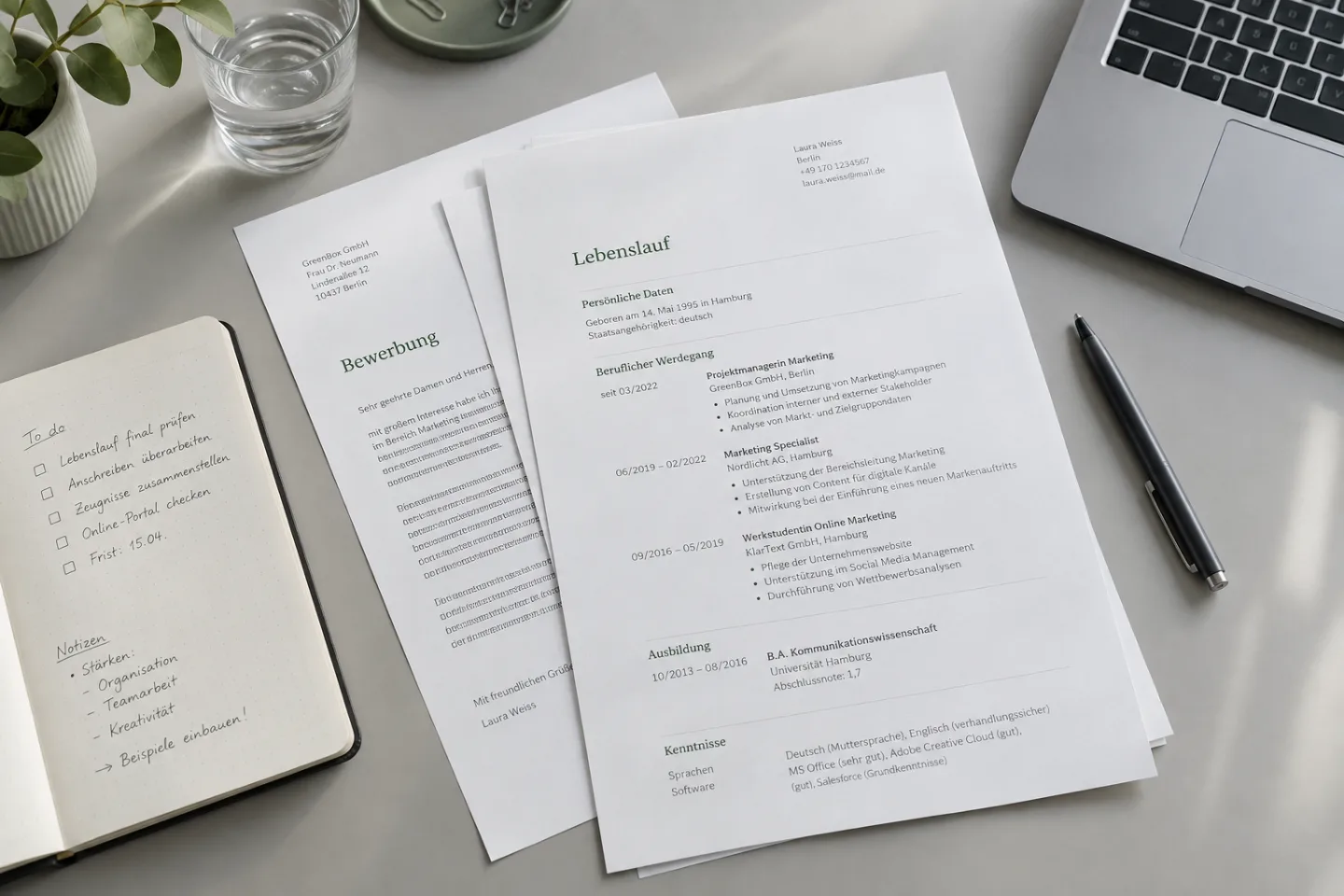
A complete sample – and what you must change
The following example shows how the arguments can connect. The person, company and details are fictional. Do not copy the text; copy the logic: name the task, prove the experience, explain the next step.
Application as Marketing Manager
Dear hiring team,
You are looking for someone who accompanies digital campaigns from planning through evaluation and brings different specialist teams together. I currently work at exactly that intersection as Marketing Manager at Studio Nord.
There I develop campaign briefings with audience, responsibilities and success criteria, align content with design and sales and evaluate the results together with the team. It matters to me that decisions are clarified before the start: that way everyone involved can point their work at the same goal.
With you I would like to use this experience for broader brand communication. I am especially interested in the collaboration between product and marketing named in the posting. I would be glad to explain in a conversation how I structure campaigns and which experience I can bring into your team.
Kind regards
Tobias Hartmann
Adapt before you send: Replace the tasks with the actual requirements, name your real contribution and check the company connection. If you are not aiming for broader brand communication, that sentence is wrong too – even if it sounds good.
Common mistakes in the cover letter
Retelling the resume
If every paragraph repeats a role in chronological order, the argument is missing. Choose a few experiences and explain what they mean for the target role.
Mirroring the job posting
Terms such as “strong communicator” or “practical” do not become more credible because they were taken from the posting. Show a situation that proves the behavior.
Praising the company too much
The application is also about your decision. Explain why the task and the setting fit, instead of repeating the company’s marketing copy.
Claiming too much
Every important statement should be explainable in a conversation. Do not invent areas of responsibility, results or skills – not even when a writing tool phrases them convincingly.
Sending a template unchanged
Templates help with structure. Names, role, motivation, examples and tone must fit the application at hand. Check the job title, contact person and company name with extra care.
Apply it now · paragraph by paragraph
The interchangeability test
In the draft, cover the company name and the job title. Would the text still fit five completely different roles without changes? Mark those paragraphs. Add a real task from the posting there and a matching experience of yours.
Then read only the first sentence of each paragraph. Together they should show: which role you are seeking, what you bring to it and why you want to take this next step.
Checklist for the cover letter before you send it
- The exact job title appears correctly in the subject line.
- The contact person and company name are spelled correctly.
- The opening names a concrete connection to the task.
- One or two examples prove the most important requirements.
- The motivation explains the role and the company without copying marketing language.
- The text does not repeat the resume paragraph by paragraph.
- Required details such as a start date have been included.
- Every claim is true and explainable in a conversation.
- Spelling, attachment and file name have been checked.
Official orientation
Further guidance is available from the Federal Employment Agency on the cover letter. Always also check the requirements of the specific job posting and the requested application route.
Your next step
Resume and cover letter. One coherent application.
Look at complete document pairs and check how the two texts complement each other. Information about the app’s features is available directly from CVura.